“Lost on the Mountain? Never Follow the Water Down!” 3 Survival Rules & Korea National Grid SOS Formula
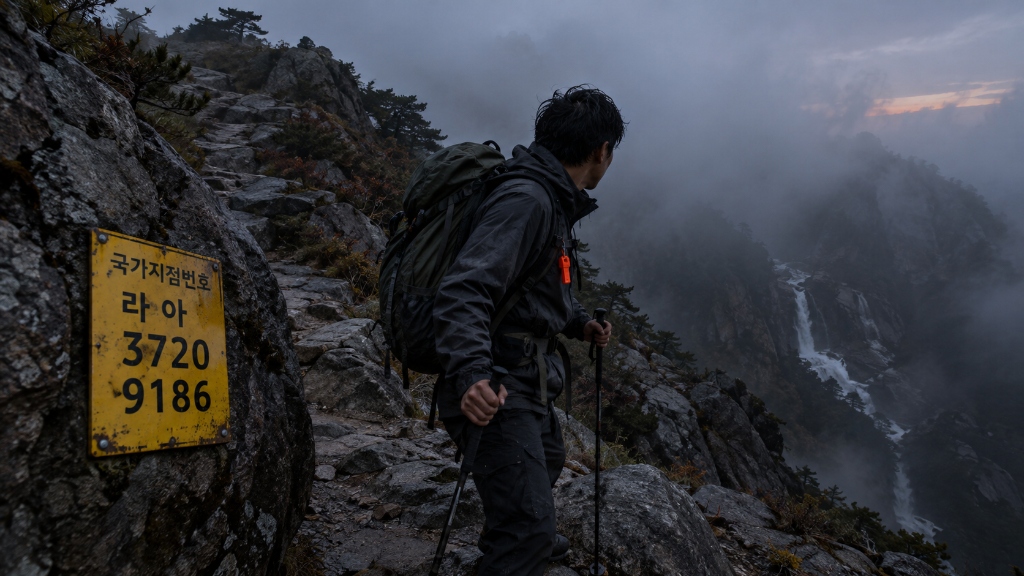
- 1Analyzes the fatal dangers of the 'Valley Funnel Trap' where descending along mountain streams leads to sheer waterfall drops and zero cell signal.
- 2Presents the 3 core survival rules of stopping immediately (STOP) and backtracking upward toward open ridgelines.
- 3Explains how to read the yellow Korea National Grid Point marker signs (국가지점번호) and execute 120dB pealess emergency whistle signals.
1. [Survival Statistics] Why 70% of Fatal Lost Hiker Accidents Happen in Valleys
- The Valley Funnel Trap: Mountain ravines that look gentle from above quickly turn into vertical cliffs and 10-meter waterfall drops, trapping hikers in impassable dead ends.
- Zero Cellular Service: Deep granite gorges block cell tower line-of-sight, making 119 SOS emergency calls and GPS data transmission completely impossible.
- Rapid Temperature Drop & Hypothermia: Sunlight disappears 2 hours earlier in ravines, and high humidity from rushing water rapidly triggers severe hypothermia even in summer.
2. [Comparison Matrix] Valley Descent vs Ridgeline Backtracking Survival Rates
| Action Strategy | 119 Cellular Connectivity | Terrain Hazard | Rescue Team Visibility | Survival Probability |
|---|---|---|---|---|
| Backtrack Upward to Ridgeline | 🔥 Clear (100% cell signal line-of-sight) | Low (Marked trails & wide visibility) | High (Helicopters easily spot open peaks) | ✅ 99% Instant Rescue |
| Follow Stream Down into Valley | 🚨 Zero (Dead zone in deep gorge) | Extreme (Waterfalls, rockfalls, torrents) | Worst (Hidden under dense canopy) | ❌ 90% Severe Risk of Fatality |
3. [Step-by-Step Survival Protocol] The 'STOP & Ridge-Lock' Action Guide
Execute the S.T.O.P Protocol
Stop moving immediately. Take a sip of water, breathe deeply, and recall the exact time and location of the last confirmed trail marker.
Backtrack Up to the Ridgeline
Never descend into the unknown. Trace your steps upward toward the highest open ridgeline where trails and landmarks are clearly visible.
Locate Yellow Grid Marker & Call 119
Find the nearest yellow metal Korea Grid Sign (e.g., 라아 3720 9186), read the 8-digit coordinates to 119 dispatchers, and maintain position.
4. [Pro Survival Tips] 120dB Acoustic & Visual SOS Signaling
- Shouting drains stamina in 10 minutes. Blow your chest-strap pealess survival whistle in 3-second blasts repeated 3 times (Beep-Beep-Beep) followed by a 1-minute pause (International SOS Code).
- At night, activate your headlamp in SOS Strobe Mode (3 short, 3 long, 3 short flashes) pointing toward the sky to guide airborne search teams.
- After reporting your coordinates, switch your smartphone to Ultra Power Saving + Airplane Mode, checking for incoming rescue calls every 30 minutes.
Common Rookie Mistakes & Proven Solutions
Smart Buyer's Guide: Mountain Survival & Emergency Signaling Gear
- •❌ Whistles with internal pea-balls (freezes or jams with saliva and moisture during critical moments)
- •❌ Relying only on flimsy disposable ponchos instead of heavy-duty Mylar space blankets
Essential everyday carry for all day hikers
All-season thru-hikers and sunrise ridge climbers
- ✓🔍 Whistle: Pealess acoustic chamber design that works in wet and freezing conditions
- ✓🔍 Thermal Blanket: 90%+ infrared body heat reflection certified Mylar film
- ✓🔍 Headlamp: Dedicated one-touch SOS strobe signaling mode
Essential Hiking & Trail Glossary
Standardized yellow safety marker plates installed across Korean mountains providing 8-digit precision coordinates for 119 rescue teams within a 10m radius.
A foundational survival navigation technique of retracing steps back to the last known trail marker rather than pushing forward into unmarked terrain.
A 50g ultralight thermal sheet that reflects over 90% of radiated body heat back to prevent rapid onset of hypothermia during emergency trail bivouacs.
Recommended Korea Mountains for this Guide
Bukhansan (Bukhansan)
High density of unmarked side trails requiring strict adherence to yellow grid signs
Seoraksan (Seoraksan)
Deep granite canyons where descending into valleys leads to severe waterfall drop-offs
Jirisan (Jirisan)
Vast terrain where emergency thermal blankets and 120dB whistles are life-saving essentials
Interactive Trail Safety Checklist
Tap each item before departing to verify readiness.
Generational Hiking Guide Series
Kids Trail Gamification & Scavenger Hunt
3 rules to turn early whining into joyful nature exploration
Couples Hiking Date & 10-Min Myth Guide
Pacing strategies, secret comfort gear, and scenic date peaks
4050 Spine Decompression & Fat Burn
Protecting lumbar discs while maximizing visceral fat loss
Hiking with Elderly Parents & Medical Kit
Barrier-free boardwalks, anti-shock poles, and medical safety